Mold Remediation in Rochester, NY
Most mold in a Rochester house is not a bathroom problem. It is a water problem that started somewhere colder - an ice dam, a spring thaw against a stone foundation wall, or a roof deck sweating in February. Fixing the mold without fixing that is how people end up paying twice.
In the Rochester area, a small contained job - one closet, one bathroom wall - typically runs $500-1,500. A finished basement after water intrusion is usually $2,000-6,000. Attic sheathing is $1,500-4,500 depending on how much decking has to be treated.
New York State licenses mold work under Article 32 of the Labor Law, and the law separates two roles: the company that assesses your mold cannot be the company that remediates it. Anyone offering to do both on the same job is either unlicensed or breaking that rule.
Rochester averages close to 100 inches of snow a year. That snow melts and refreezes at the roof edge, and the water it pushes back under the shingles is the single most common starting point for attic and top-floor mold here.
Why cold-climate mold looks different
Ask most people where mold grows and they will say the bathroom. In a warm humid state that is often right. In Rochester it usually is not. Our humid season is short, and the months that cause trouble are the cold ones, because that is when water gets into a building envelope and then has nowhere to go.
Three mechanisms account for most of what local contractors are called out to. Each of them starts with liquid water, not with steam or humidity, which is why a dehumidifier alone rarely solves it.
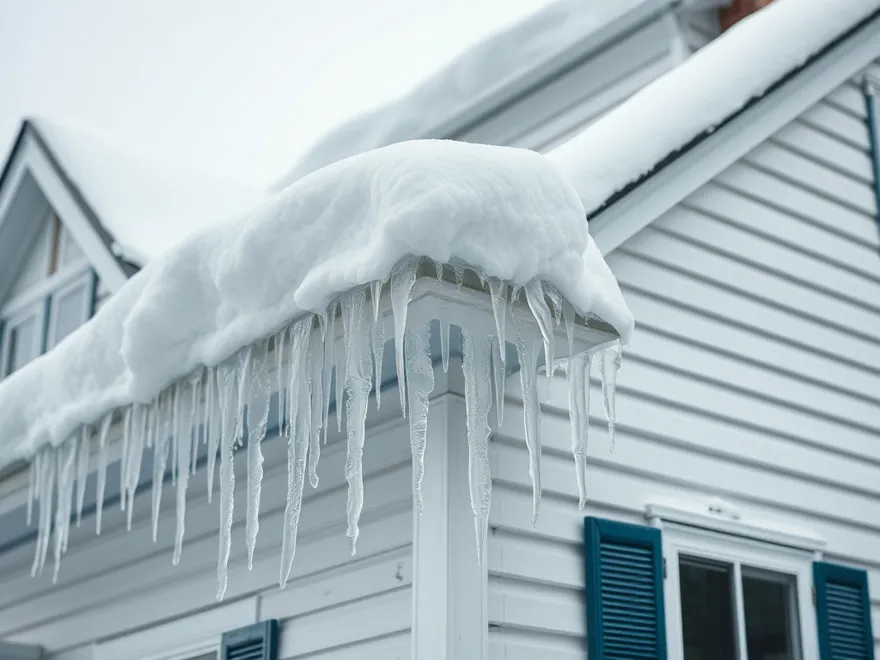
The ice dam is the usual suspect
Heat escapes into the attic, warms the underside of the roof, and melts the bottom layer of the snowpack. That meltwater runs down to the eave, which is cold because there is no attic below it, and refreezes into a ridge of ice. The next round of meltwater backs up behind that ridge and finds its way under the shingles.
The damage does not show up as a dramatic leak. It shows up months later as a stain on a bedroom ceiling, or as dark blotching on the underside of the roof deck that nobody sees until an inspection. By then the wood has been damp through several cycles.
This is why an honest contractor in Rochester will ask about your roof and your attic insulation before quoting the mold work. If the ice dam comes back next winter, so does the mold.
The second one is under your feet
A large share of Rochester's housing stock predates 1940, and houses of that era were built on stone or early poured foundations with no vapour barrier and no exterior waterproofing membrane. That was fine when the basement was a coal cellar. It is less fine now that it is a finished family room with carpet and drywall.
Spring is the pressure test. Frozen ground cannot absorb meltwater, so it runs along the surface until it finds the lowest point, which is often the soil against your foundation wall. Water moves through masonry slowly but reliably, and the first thing it reaches on the inside is the back of the drywall - the one surface nobody can see.
If your basement smells musty in April but not in August, that is a seasonal water story, not a humidity story. Remediation alone will not stop it recurring.
Finished basements cost more to remediate than unfinished ones for one reason: the affected drywall, framing and insulation usually have to come out before anything can be treated.
What a job here actually involves
- Find the water. Not the mold - the water. A contractor who starts scrubbing before answering this is treating a symptom.
- Contain the area, usually with plastic sheeting and negative air pressure so spores are not pushed through the rest of the house while work is underway.
- Remove what cannot be cleaned. Porous materials that have been wet - drywall, insulation, carpet pad - generally come out rather than get treated in place.
- Clean and treat what stays: framing, sheathing, masonry.
- Dry the space properly, and fix the water source. If step one was skipped, this is where the job quietly fails.
The licensing rule most homeowners miss
New York is one of a small number of states that regulate mold work directly. Under Article 32, contractors doing mold remediation above a minimum job size must hold a state licence, and - this is the part worth remembering - the assessor and the remediator must be different companies.
The reason is obvious once stated. A company that both diagnoses the problem and gets paid to fix it has an interest in finding a big problem. Splitting the roles removes that. If a company offers to test your air and then remediate based on its own results, that is a reason to keep looking.
Common questions
Do I need a mold test first?
Often not. If you can see mold and you know where the water came from, testing mainly confirms what you already know and adds several hundred dollars. Testing earns its keep when you cannot find the source, when someone in the house is unwell and a doctor has asked, or when you need documentation for an insurance claim or a sale.
Will my homeowners insurance cover it?
It depends entirely on the cause, not the mold. Sudden and accidental water - a burst supply line - is usually covered. Long-term seepage, a roof that needed replacing, or groundwater are usually not. Many New York policies also carry a specific mold sub-limit, often a few thousand dollars, which is worth reading before you assume you are covered.
Is black mold different?
Not in the way the phrase implies. Colour does not reliably tell you the species, and the practical response is the same either way: find the water, contain the area, remove what is porous and wet. Any contractor who leans hard on the phrase to sell a bigger job is selling, not diagnosing.
How long does it take?
A small contained area is often one day. A finished basement is typically two to four days including drying time. Attic work depends on how much decking is affected. Beware anyone promising same-day completion on a large job - the drying step cannot be rushed.
Can I do it myself?
A patch smaller than about ten square feet on a hard surface, where you know the water source and have fixed it, is a reasonable DIY job with proper protection. Anything larger, anything inside a wall cavity, and anything you cannot explain the cause of is worth a professional - mostly because containment is the part amateurs get wrong, and doing it badly spreads the problem.
- Rochester
- Irondequoit
- Greece
- Brighton
- Penfield
- Webster
- Gates
- Henrietta
Get quotes from a Rochester contractor
Tell us where you are seeing the mold, roughly how big the area is, and when you first noticed it. We pass that to one independent Rochester-area contractor who quotes in writing. No charge for the match, no obligation, and we do not sell your details on.
Or call (877) 701-2518